Was Port Harcourt's Garden City Ever Meant to Be Built?

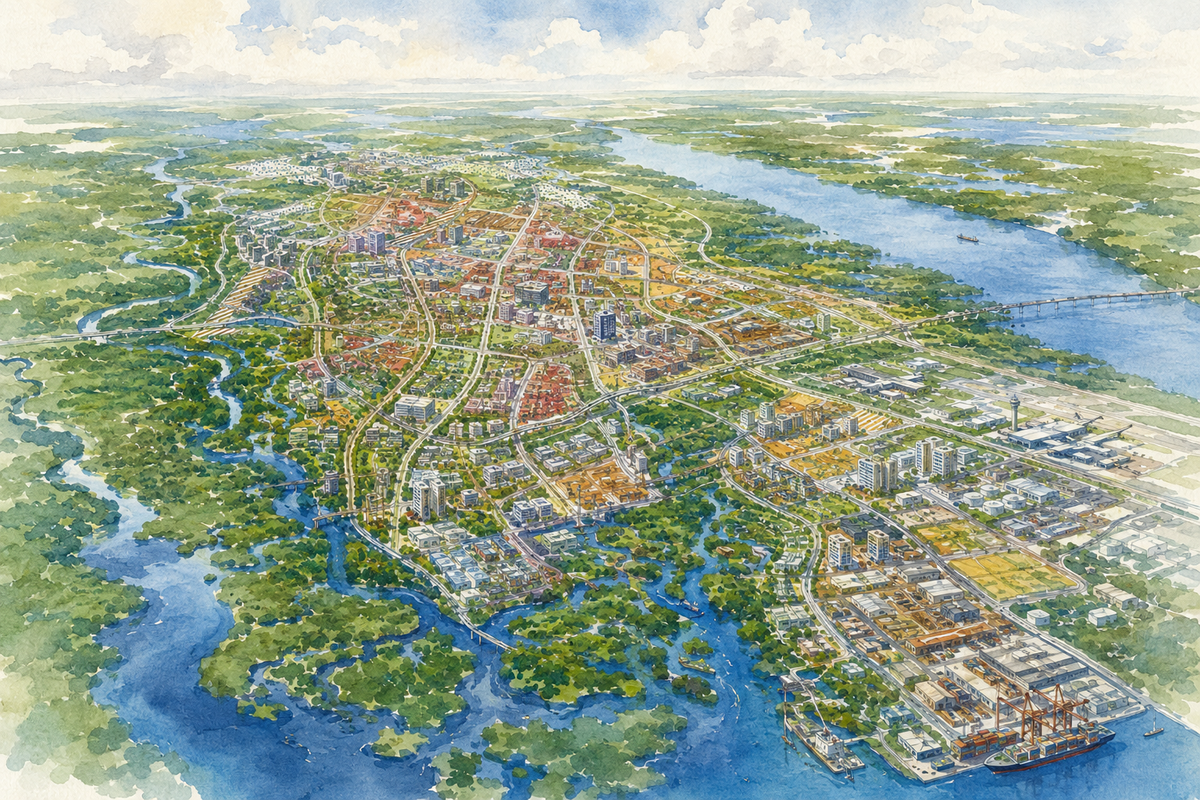
In August 2009 the homes and businesses of nineteen thousand people in Port Harcourt, Nigeria were reduced to rubble over the course of a single weekend. Security forces moved through the Njemanze waterfront community with bulldozers and no warning. There was no compensation. There was no resettlement plan. There was nowhere for the displaced residents to go. As they picked through the debris of their former lives, the Governor of Rivers State declared his vision to transform Port Harcourt into a garden city, a world-class metropolis worthy of Nigeria's oil capital. Two years later the demolished site remained derelict and overgrown, returning to nothing. The garden city had not arrived to replace what had been destroyed.
It never would.
This sequence is not incidental to the Port Harcourt story. It is the Port Harcourt story. And understanding why requires understanding a specific political instrument that African governments have deployed with remarkable consistency: not the gleaming rendering, not the international architecture firm, not the sovereign wealth fund backing a prestige project, but something far more modest and far more common. A plan on a map. A development authority established by law. The bureaucratic apparatus of city-building assembled without any serious intention of building a city.
The Plan as Political Instrument
Port Harcourt's Greater New Town project never had the spectacular visual ambition of a Gulf megaproject. Governor Chibuike Amaechi's 2008 announcement was backed by a master plan produced by a South African firm, a newly created Greater Port Harcourt City Development Authority with legal standing, and a program document outlining projected populations and infrastructure targets. It was not Neom. It was not even Eko Atlantic. It was a map, a vision statement and a government body with a mandate.
That was enough. It did not need to be more than that because the plan was never primarily a blueprint for construction. It was a political instrument with several distinct uses. It gave the government a development rationale it could invoke when demolishing informal settlements, framing clearance as a necessary precondition for progress rather than an act of dispossession. It signaled modernizing intent to domestic audiences and potential investors without requiring the commitment of actual capital. It created a legal and administrative framework that concentrated land control in state hands. And it gave successive governors something to relaunch, rebrand and re-announce whenever they needed to demonstrate vision without delivering anything.
Research has confirmed the gap between the plan's ambition and its resourcing. One academic study found that only 27 percent of budgeted funds for the project were ever released. The plan existed in full. The money to execute it barely materialized. This was not a planning failure. It was a planning success, because the plan was doing its actual job without needing the money.
A World Building Cities
African leaders had genuine reasons to believe in the new city model. The world had been building new cities at an extraordinary pace. China was producing entire metropolitan areas from farmland at a speed and scale without historical precedent. Shenzhen went from a fishing village to a metropolis of thirteen million people in less than forty years. The Gulf states were demonstrating that with sufficient capital and political will a city could be conjured from almost nothing in a generation. These were real achievements and they suggested that the new city was a replicable technology, a tool that ambitious governments could pick up and use.
What was less visible from a distance was how specifically demanding the conditions for even partial success actually were. China's city-building was an expression of state capacity assembled over decades: the ability to direct credit from state banks into municipal infrastructure, relocate populations through administrative coordination and sustain construction programmes across political cycles. The Gulf projects rested on sovereign wealth that could absorb decades of losses while a city slowly populated. KAEC in Saudi Arabia has a functioning port and a partial population because the Saudi government could carry the project through years of underperformance on oil receipts that flow regardless of whether the city performs.
Neither model was available to the governors who announced African new cities. What was available was the administrative vocabulary of city-building, the development authority, the master plan, the projected population figure, the infrastructure target. These could be produced quickly and cheaply. They looked like the first steps of something real. And in the absence of the capacity to build what China built or the wealth to absorb losses the way the Gulf could, they became the entirety of the project rather than its beginning.
480,000 People Off the Map
The waterfront communities of Port Harcourt, home to roughly 480,000 people in dozens of informal settlements that had grown up around the river edges of the city over generations, had been left off municipal maps for decades. They appeared in the city's development thinking not as neighborhoods to be upgraded or integrated but as obstacles to a future that existed only on paper. The master plan gave that future legal standing. The development authority gave it institutional form. Together they provided the framework within which demolition could be described as urban renewal and displacement could be described as progress.
The resistance that emerged was sophisticated in ways that are worth understanding. The Collaborative Media Advocacy Platform, known as CMAP, built a coalition that included Amnesty International, UN-Habitat and the Netherlands Foreign Ministry. It established a community radio station and a mobile cinema in the waterfronts. It pursued litigation at the ECOWAS Court of Justice. It ran international campaigns that produced a 27-month halt to demolitions. Most pointedly, it commissioned the first participatory mapping of waterfront settlements that had never appeared on any official city map, producing the kind of granular community-level data about population, land use, employment and infrastructure that the government's master plan had never bothered to generate about the people already living in the city it was planning.
I know something of this because in 2013 CMAP called me about a GIS position. The connection from Port Harcourt was poor. The team was blunt in a way that was unusual for people recruiting a candidate. The conditions were hard: persistent illness, inadequate infrastructure, the daily difficulty of working in communities that lacked everything the city's master plan promised to provide. They were also clear about what they were working against. The new city project, I remember them telling me, was a corrupt pipe dream. The plan was not realistic. There was no path forward to actual construction. The real function of the whole exercise was the removal of people from land that the state government wanted cleared.
They were right on every count.
The Bureaucracy of Phantom Cities
What makes Port Harcourt instructive rather than simply depressing is how clearly it illustrates a phenomenon that differs importantly from the more internationally visible African city projects. Eko Atlantic in Lagos, the partially constructed high-end enclave rising from reclaimed ocean, does have international backing, international architectural involvement and at least the ambition of building something for someone, even if that someone is a narrow elite entirely disconnected from Lagos's actual housing needs. Hope City in Ghana attracted international design firms and generated global press coverage before construction stalled. These projects were aimed at least partly at a global audience and required global credibility to function.
Port Harcourt's project required none of that. It needed only the domestic legitimacy that a formally constituted planning authority and a legally recognized master plan could provide. This made it cheaper to produce, easier to sustain across political transitions and more directly useful as an instrument of local land control. It is also, for precisely these reasons, far more common across the African continent than the prestige projects that attract international attention. The plan that exists to be invoked rather than implemented, the development authority that provides legal cover for whatever the government wants to do with urban land, the vision statement that gets relaunched by each new administration with updated branding and identical intentions: these are the ordinary tools of African urban governance in cities where the formal planning system and the actual development of the city have almost nothing to do with each other.
What Actually Works
The contrast with projects that have delivered something real clarifies what the missing ingredients actually are. Tatu City in Kenya, developed by Rendeavour with private capital and genuine project management, has built a functioning mixed-income community outside Nairobi with schools, a hospital, residents and businesses. It did not happen through a government development authority with a master plan and 27 percent budget release rates. It happened because the development model was structured around private capital that had to perform, project management accountable to investors rather than to political cycles and a delivery timeline that could not be indefinitely deferred. The lesson is not that African city-building is impossible. It is that the mechanisms that produce real outcomes are structurally different from the mechanisms that produce plans.
The City That Keeps Being Announced
Back in Port Harcourt the cycle continues. Governor Fubara has relaunched the new city vision under new branding, anchored this time near the port of Onne with a joint venture partner and updated documentation. There is a planned tourist beach development. There is a PH-Airport City aerotropolis concept. There are smart city proposals from private developers. The Greater Port Harcourt City Development Authority still exists. The waterfront communities remain largely unmapped by the state, underserviced and periodically threatened. A 2022 civil society coalition estimated that planned evictions in the Diobu area alone could displace 60,000 more people.
The most tangible piece of urban infrastructure produced by a decade of planning activity in Port Harcourt was the media shed at Okrika waterfront, built by CMAP volunteers in 2012 and 2013 with international donor funding. Not by the government with oil revenues. By the people the government's plan was designed to move.
Africa will build cities because it has to. Its urban population is projected to nearly triple by 2050, adding close to a billion new urban residents to a continent already straining under the weight of the ones it has. The question is not whether African urbanization will happen. It is happening now, chaotically and at enormous scale, in the informal settlements and expanding peripheries of existing cities that no development authority has seriously tried to plan for.
The question is whether the institutional tools deployed to manage that growth will be the ones that work or the ones that provide the most useful political cover. Port Harcourt has been answering that question the same way for fifteen years. The plan gets updated. The authority persists. The waterfront communities stay where they are, mostly, and wait to see what the next announcement brings.


