Inside China's Pig Towers


Before you can enter the building, you have to be cooked.
Not literally, but close enough. Visitors to the world's tallest pig farm, a 26-story tower on the southern outskirts of Ezhou, a mid-sized city in China's Hubei province, must pass through a sealed chamber where dry heat reaches 65 degrees Celsius. You stand there for half an hour. Then you shower. Then the next morning you shower again before you are allowed onto the production floor. Staff who work inside are permitted to leave once a week. When they return the whole ritual starts over: shower the day before, swine fever sampling, another shower at the disinfection center, the heat chamber, another shower, dormitory, another shower in the morning. Workers report that before each wash, shampoo is squeezed directly onto their heads to ensure nobody skimps.
The building that justifies all this is hard to describe without sounding like you are making it up. From the outside it looks like a large office tower or an unremarkable residential block, the kind of grey concrete slab that lines ring roads across the Chinese interior. It is, in fact, the largest single-building pig farm on earth. Its two identical towers, a second now operational, stand 26 floors tall on a plot that until recently was farmland, rising above every other structure in the township of Bishidu. Each building covers 390,000 square meters of floor space. Together they produce 1.2 million pigs a year.
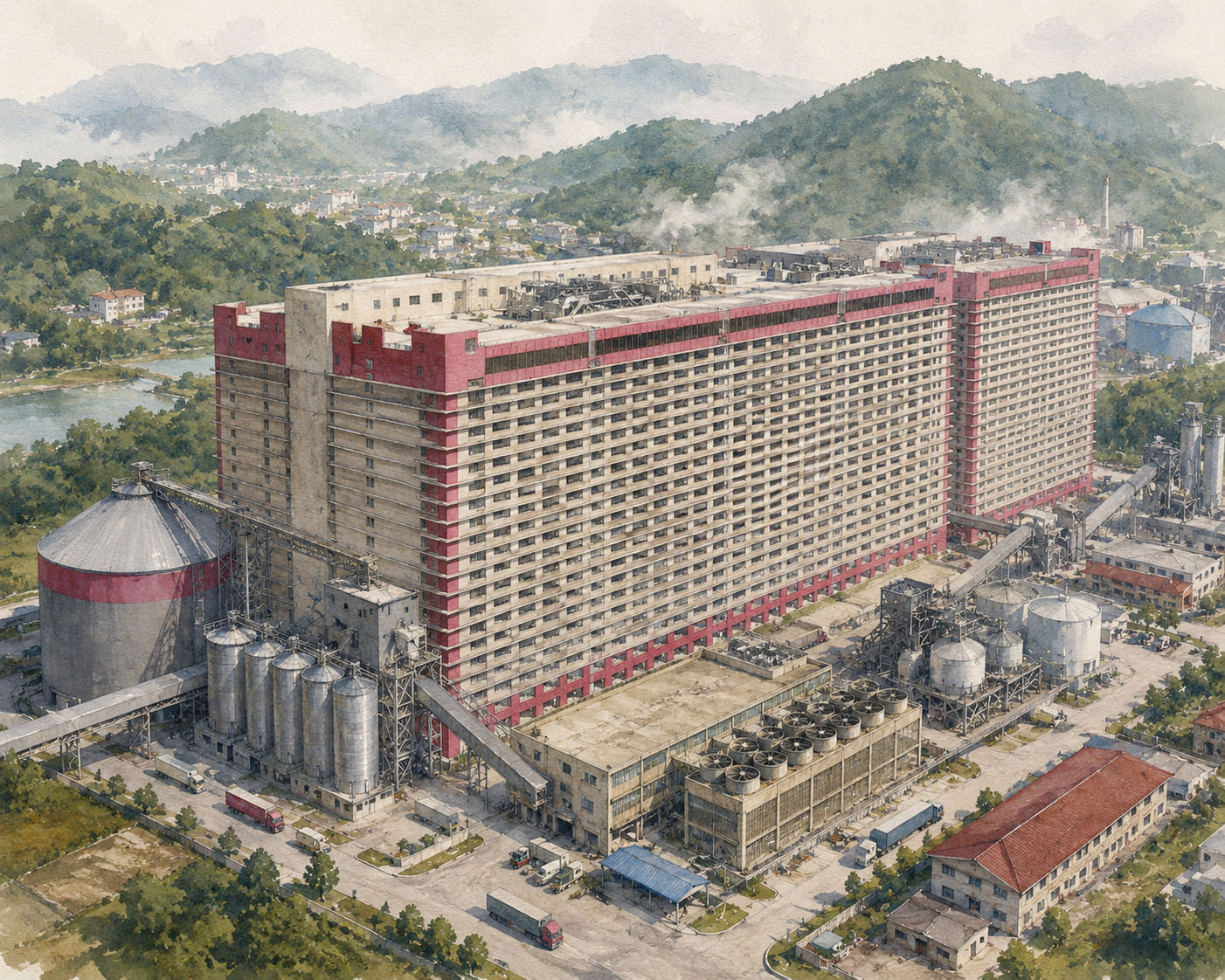
Denmark, one of the world's largest pork exporters, raises roughly 18 million pigs annually across an entire country. The two towers in Ezhou, combined footprint of a large shopping mall, will eventually match the annual output of some mid-sized pork-producing nations.
The towers were built by a company called Hubei Zhongxin Kaiwei Modern Animal Husbandry. The backstory of who actually built them and why is one of the stranger subplots in recent Chinese industrial history. Zhongxin Kaiwei's parent company is a cement manufacturer, and its founder Zhuge Wenda made his fortune in construction materials before deciding, without obvious prior expertise in agriculture, to design and build the world's most ambitious pig farm. The cement plant sits a short distance from the towers. Whether this constitutes elegant vertical integration or simply a wealthy man's audacious diversification depends on your perspective. Either way, he built it.
Chinese social media users, upon seeing the towers, immediately reached for mythology. They dubbed the buildings the Bajie Buildings, a reference to Zhu Bajie, the pig-faced monk from the classic novel Journey to the West known colloquially as Second Elder Brother. The joke spread quickly on Weibo. "Second Elder Brother has moved into a high-rise." It was affectionate and absurdist, but it captured something real. In a country where hundreds of millions of rural residents have spent three decades migrating into urban apartments, the pigs had gotten there too.
Inside, the towers operate with precision. This is not a farm in any recognizable sense. It is closer to a semiconductor fabrication plant or a data center. One American analyst quoted in the New York Times called it "Foxconn for pork." Every pig that enters the building receives an identity document, an electronic ID that tracks its origin, pregnancy history and birth records for its entire life in the tower. Feed is distributed automatically from a central control room on the first floor via a DCS industrial control system of the kind typically used in chemical plants or power stations. Room temperature and humidity are maintained floor by floor. Waste is processed through biogas systems that convert methane into energy, cutting odorous emissions by more than 90 percent, with waste heat piped to the adjacent cement plant. The towers are, in theory, nearly self-powering.
Moving animals through a 26-story building required custom engineering. The freight elevators are 18 square meters, capable of carrying up to 70 pigs at a time, with a maximum load of 10 tons. A trip from the ground floor to the 26th takes 15 minutes. To coax reluctant animals in, speakers inside play recordings that mimic the sound of a person herding pigs. Press the button and the animals, deceived by the familiar noise, file in obediently.
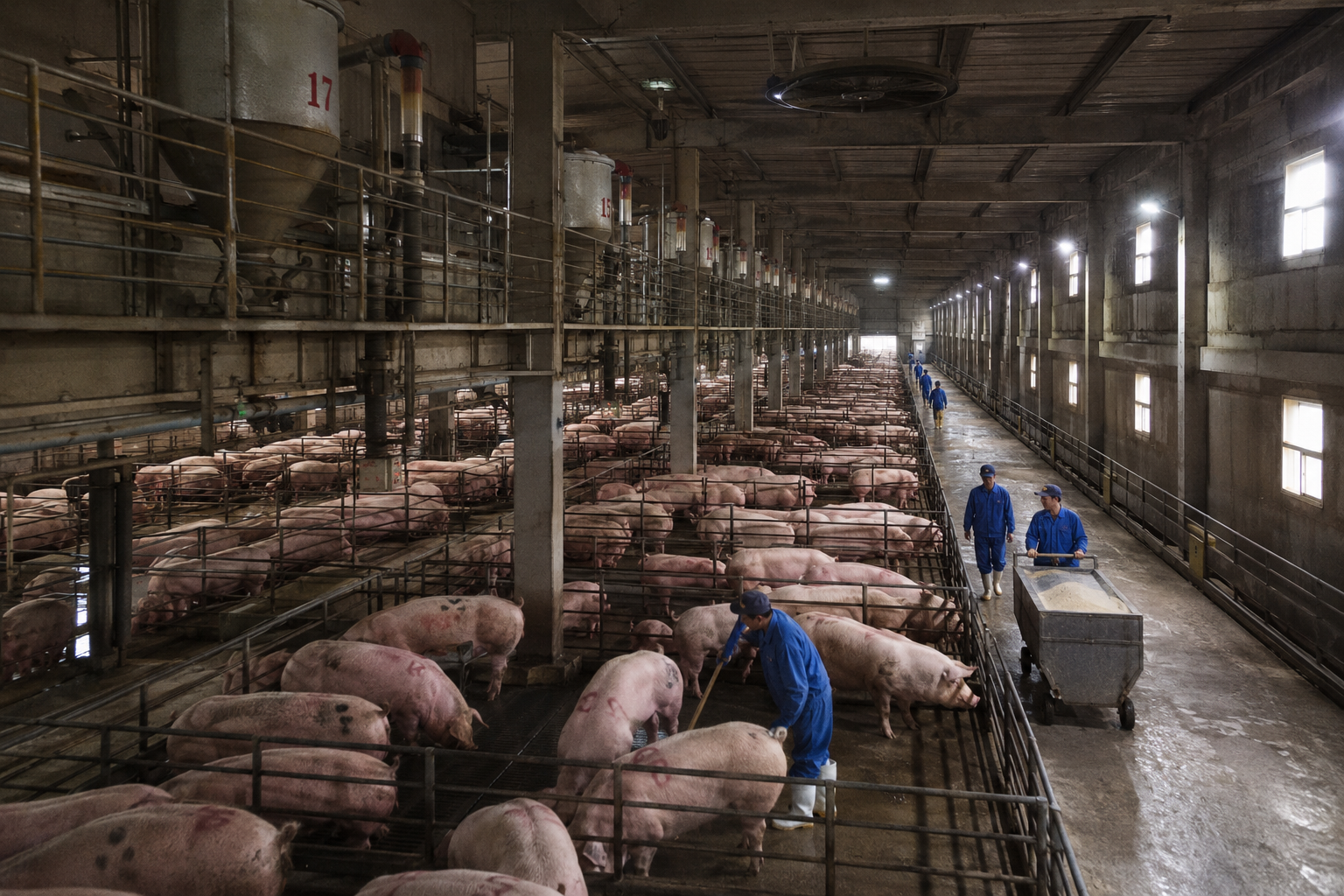
One floor worker, a 30-year-old veterinary technician named Sun Kaineng who had previously managed a conventional pig farm in Hubei's Xiangyang city, told Chinese journalists the monthly salary was 20,000 yuan, roughly $2,800 and a substantial wage by Chinese agricultural standards. The company installed treadmills, ping pong tables and billiard tables in the workers' recreational area. The amenities are presumably meant to compensate for the fact that leaving is a production event.
To understand why China built this, you have to go back to 2018.
In August of that year, African swine fever was detected in China for the first time. The virus kills pigs with the lethality of Ebola in humans, and there is no commercially available vaccine. It spread with catastrophic speed. Within eighteen months China had lost somewhere between 40 and 50 percent of its entire pig herd. Some estimates put the death toll at 180 million animals. At the outbreak's start China had over 400 million pigs, more than half the world's total, and the loss was staggering. Pork prices doubled. Inflation hit an eight-year high. The government dipped into strategic reserves of frozen meat. Imports surged from the United States, Europe and Brazil.
Pork is a dietary staple in China, culturally embedded in a way that has no Western parallel. The word for "meat" in many Chinese dialects defaults to pork. When prices spike it registers as a basic cost-of-living crisis and the political sensitivity is acute. Food security, already a priority in Beijing's policy framework, became an emergency.
The government's response was multi-story pig farming. Multi-story pig farming had previously been illegal in China. In 2019 it was authorized. New agriculture policies pushed the consolidation of the industry away from the millions of small backyard operations that had long dominated Chinese pig farming and toward large, biosecure, industrial facilities. Companies that had survived the swine fever outbreak, mostly the ones like Muyuan Foods that already owned large integrated facilities, suddenly had capital and policy wind to expand aggressively. Muyuan's profits grew 1,413 percent in the first nine months of 2020.
Multi-story pig farms have been proliferating across China at roughly 30 percent annual growth since 2020. Muyuan, now the world's largest pork producer by sales, raises pigs in buildings up to six stories high across dozens of facilities. New Hope Group, Wen's Foodstuff Group and others have all moved into vertical farming. What was an emergency measure has become the industry's norm.
The consolidation has been brutal for small farmers.
Before the swine fever crisis, over 99 percent of China's pig farms produced fewer than 500 animals. The backyard pig, fed on kitchen scraps and raised over the course of a year, was a fixture of rural life across the Chinese interior. By 2023 the national count of smallholders had fallen 41 percent from 2018 levels. In some regions the exit rate reached 80 percent. By 2024 scaled industrial operations accounted for more than 70 percent of national pig production. The economics had made small farming essentially untenable. Large operations brought production costs down to 12 to 13 yuan per kilogram through digital management and low-protein feed technology, while smallholders lacking the technology and capital remained at 16 yuan or above. When pork prices dropped sharply in 2023 the small farmers were the ones who could not survive the cycle.
One researcher at the Zhongguancun Internet Finance Institute, put it plainly on social media after the towers became national news: "A 26-floor pig tower, raising pigs the way you'd manufacture iPhones. Under this model, small-scale rural farming has absolutely no future." In speaking to one small farmer myself in China, the desperation was palpable.
The towers embody the Chinese tendency to solve serious problems by scaling up the solution until the problem cannot reach you. The swine fever outbreak came from small, dispersed, poorly controlled farms. The answer therefore is large, concentrated, rigorously controlled towers.
Whether this logic holds up keeps experts uneasy. The same density that makes the towers efficient makes them catastrophically vulnerable if the defenses fail. Airflow between floors poses containment challenges. If disease enters it moves through a population of hundreds of thousands of animals in a single structure.
The concern is not hypothetical. Shortly before a Global Times journalist visited the Ezhou facility in 2023, a batch of newly arrived breeding pigs was found to be carrying African swine fever. The company contained it. But the virus, the very thing the towers exist to defeat, had gotten inside.
The general manager described the containment protocols: continuous high-activity oxidant disinfection throughout the facility, constant screening of the herd for abnormal animals and multiple redundant systems.
The towers are being exported. Muyuan Foods is working with a Vietnamese agricultural company to build high-rise hog facilities in Vietnam's Tay Ninh province, the first overseas deployment of the model, bringing not just capital but the production logic China developed in the years after the swine fever crisis. What was a domestic emergency response is becoming an exportable template.
From a highway in Bishidu township, the two grey towers rise above the low roofline of vegetable gardens and scattered houses. They are the tallest buildings for miles. Inside each floor, rows of individual pens stretch from one end of the building to the other. Each pen holds one pig. The pig has a file. Its temperature is monitored. Its waste is accounted for. It will never go outside. It will ride an elevator. In roughly six months, much faster than the year it would have taken on a backyard farm, it will leave the way it came in.
Second Elder Brother has moved into the high-rise. There are 600,000 of him.


