Fusion Power, Lab-Grown Food, and Brain Interfaces: The Technologies That Will Reshape Cities by 2100

In 1898, the great cities of the Western world sent their best urban planners to London for the first international planning conference in history. The crisis on the agenda was horse manure. New York City alone was producing 2.5 million pounds of it a day. The delegates were not fools. They were rigorous professionals who measured, modeled, and debated collection systems, disposal infrastructure, and manure-to-energy conversion schemes. A follow-up conference was scheduled for 1900.
The follow-up conference was never held. Within a decade, the horse had essentially vanished from city streets. The automobile had arrived and rendered the entire problem irrelevant.
The lesson most people take from this story is that we should be humble about prediction. That is true. The harder lesson is that those planners were the best minds of their era, working seriously on the most pressing urban problem of their time. Their failure wasn't stupidity or lack of rigor. It was that the thing that was going to change everything was not visible yet, and the very sophistication of their analysis of the visible problem made them less likely to look up and notice what was coming.
That is the permanent condition of city building. And anyone who is currently designing a master plan, laying utility infrastructure, or deciding what a new city's economy will be organized around should sit with that for a moment before continuing.
There is More, and Vastly More Rapid Change Now Than Ever Before
In 1800, roughly 20 million people on earth lived above the threshold of absolute poverty, the level at which a person has enough economic security to think about something beyond immediate survival. That was the entire global innovation population: the full cohort of humanity with the bandwidth to ask not just "how do I eat today?" but "could things work differently?" Out of that 20 million people came the Industrial Revolution, the railroad, germ theory and the modern city. By 1850 it had grown to 50 million. By 1970, a billion. Today, 90% of eight billion people live above that threshold. The global innovation population is roughly seven billion, 350 times larger than the cohort that produced the Industrial Revolution, and connected to each other at a speed that has no historical parallel.
This means the pace of change that produced everything we consider modern, including the automobile, the airplane, the computer, the internet, the smartphone, was generated by a tiny fraction of today's creative capacity. Whatever is coming next will come faster, from more directions, and from places that no conference, no master plan, and no set of architectural renderings is currently tracking.
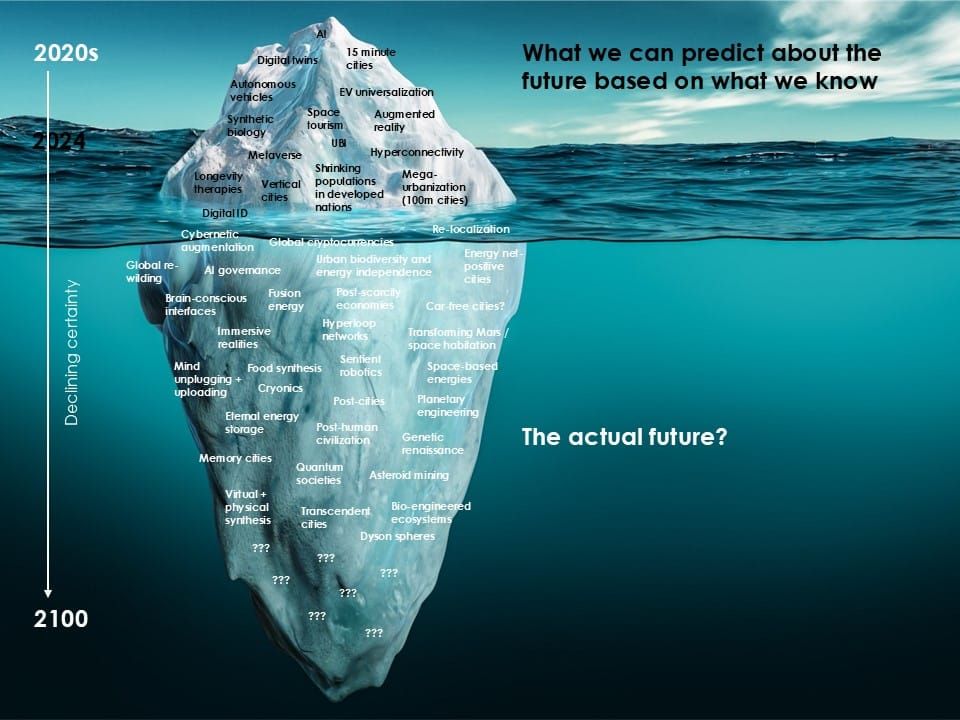
The iceberg diagram attached to this piece tries to capture something true about this: above the waterline are the things we can see, plan for, and are already building into zoning codes and infrastructure specifications. Below it is everything else: the stuff that will actually determine what cities look like in 2075. Most city building, everywhere in the world right now, is focused on the top six inches of ice.
The Tip of the Iceberg...
The visible trends shaping urban discourse right now are consequential.
Artificial intelligence is already reshaping urban economic geography faster than most cities have absorbed. AI companies represented 25% of all office leasing in San Francisco in 2025 and roughly 80% of net new growth. In Manhattan, AI firms added a million square feet of office space in 2025, a 152% jump from the year before. This is the railroad junction effect in real time: cities that capture AI infrastructure and talent are locking in structural advantages that will compound for decades. Cities that don't are losing ground faster than they realize. The agglomeration logic of cities (why businesses cluster in the same place) is not weakening in the AI era. If anything it is intensifying, but reorganizing itself around a different set of anchor industries than the ones that built the last generation of great cities.
Autonomous vehicles are doing something less visible but ultimately more spatially significant: they are beginning to unbind urban form from the parking lot. A typical American city dedicates between 30% and 50% of its downtown land area to parking. New York City has roughly 3 million curbside parking spaces. If even 20% of that is eventually freed by autonomous vehicle adoption, the resulting developable land is the equivalent of nearly two Central Parks in Manhattan alone. Across American cities the land release would be enormous. The question of what fills those spaces, whether housing, parks, production, or retail, will be one of the defining urban design questions of the 2030s, and almost no city is planning for it seriously right now.
Electric vehicles are doing to the petrol station what the automobile did to the livery stable. The most ubiquitous commercial land use of the 20th century city, the corner gas station, highway service plaza, parking forecourt with pump island, is beginning a long decline. The land underneath those stations, often in prime locations on major arterials, represents a redistribution of urban commercial real estate that will take decades to fully play out but is already starting.
The people working on these issues are right to do so. But they are all, without exception, extensions of things that already exist. They are the visible tip.
Just Below the Surface...
There is a zone between the predictable present and the unknowable future where some of the most interesting possibilities live. This is a layer that includes real programs with potential funding and real timelines, whose urban implications are not yet being taken seriously.
Fusion energy is the one that could rewrite the most. In October 2025, the US Department of Energy released a national fusion roadmap targeting commercial power on the grid by the mid-2030s. Commonwealth Fusion Systems has over $2 billion in funding and is building toward its first commercial plant in Virginia. Helion Energy, backed by Sam Altman, has a power purchase agreement with Microsoft and is targeting 2028. The IAEA's 2025 World Fusion Outlook found that 35 out of 45 fusion companies expect to have commercially viable pilot plants operating by 2030 to 2035.
The urban implications of actually abundant, clean, cheap energy are transformative at the level of urban foundations. Every constraint on how dense a city can grow, from water supply to waste processing to heating and cooling costs, to the energy intensity of vertical construction, is ultimately an energy constraint. Remove that constraint and cities that are currently economically impossible to build at high density become possible. Arid regions that currently cannot support large populations without enormous infrastructure investment become viable. The desalination of seawater at urban scale, prohibitively expensive on renewable energy alone, becomes routine on fusion power. This portends a potential rewrite of the map of where human settlement can exist.
Food production decoupled from agricultural land is further along than most urban planners have registered. Vertical farming, defined by crops grown in stacked, controlled-environment layers inside warehouses and repurposed buildings, already uses 95% less water than conventional agriculture and produces dramatically higher yields per square foot. AeroFarms in Newark produces leafy greens at 390 times the yield per square foot of conventional farming. Tokyo runs vertical farms inside office buildings and underground stations. Singapore is building toward genuine food production self-sufficiency within its city boundaries. Cellular agriculture, defined by meat produced from cell cultures rather than animals, is in commercial production in several countries.
The deeper implication is about urban-rural relationships that have organized human settlement for ten thousand years. If a city of two million people can produce a meaningful fraction of its own calories within its own boundaries, as Singapore is actively attempting, the economic relationship between urban centers and agricultural hinterlands begins to shift. So too does the dependence of countries with agricultural net deficits on those with agricultural net surpluses. For Africa, where a large share of current urbanization is driven by agricultural displacement pushing people into cities that have no jobs waiting for them, this could reshape migration patterns in ways that no current master plan is accounting for. The city that learns to feed itself is a different kind of city than any that has existed before.
Brain-computer interfaces are the technology whose urban implications are least discussed and potentially most significant. Neuralink raised $650 million in July 2025 at a $9 billion valuation. Beijing published a formal action plan in 2025 for accelerating BCI development through 2030. The Greater Bay Area in China is actively competing to become the world's leading BCI cluster. The current state of the technology, a paralyzed patient controlling a computer cursor with their thoughts, sounds modest, but the trajectory is not.
The reason this matters for cities is that so much of what cities are for is cognitive and communicative. People move to cities to access other people, to collaborate, to encounter ideas and opportunities. The friction of that access, including the commute, the office, the conference and the coffee meeting, is what drives urban density. If the friction of cognitive collaboration drops toward zero, if the experience of working with someone in the same room becomes replicable across distance at sufficient fidelity, the economic geography of agglomeration changes. Not necessarily toward dispersal, but toward a reorganization of which activities require physical proximity and which don't. Nobody has seriously worked out what that means for how cities should be built.
The Deepest Waters...
Below the zone of partial visibility is the territory where honesty requires simply saying: we don't know, and the history of cities tells us that the things we don't know are the things that matter most.
The innovations that will define urban life in 2075 are, by definition, mostly not visible yet. Some of them have not been conceived. Some exist in research programs that have no funding. Some are in the notebooks of people who are currently in secondary school. The global innovation population of seven billion people, operating across the next fifty years, will produce things that will make the current generation of smart city visions look as quaint as a manure collection scheme.
What we can say is that the categories of possibility that existing urban thinking is most unprepared for include genetic and biological engineering of the built environment itself, materials that grow, repair themselves or change properties in response to conditions, quantum computing applied to urban systems optimization at a scale that makes current computational urban management look rudimentary, and whatever emerges from the convergence of AI, biotechnology, and materials science in ways that currently have no name.
The cities and new urban projects being built right now that are most tightly specified, most perfectly optimized for a particular vision of how people will live and move and work in 2030, are the ones most at risk from what comes after 2030. NEOM's The Line was envisioned to be 170 kilometers long and 200 meters wide, a single prescribed form with one way of moving through it. It was, in its full vision, arguably the most perfectly optimized large-scale urban project in human history, and it was optimized for a vision of 2030 that 2060 will find as legible as we find 1898's manure management systems today. It's likely a good thing it was scaled back, and if it ever does fill out and expand, those expansions will likely look very different from the original 2020s vision.
How Should Infrastructure Adapt for an Uncertain Future?
The point of the iceberg is not paralysis. Cities have to be built. Infrastructure has to be laid. Commitments have to be made. The question is what kind of commitments are most durable across the widest range of possible futures.
The answer that history keeps returning to is generic over specific, adaptable over optimized, bones over vision. The cities that have survived centuries like London, Istanbul, Amsterdam and Rome, did not survive because their founders predicted the future correctly. Rome has been reinvented numerous times, grown and shrunk, and even today is trying to figure out its infrastructure for the future. These cities survived because their street grids were fine-grained enough to be repurposed by each successive era, their waterfronts accessible to successive generations of transportation technology and their mixed-use density able to host whatever combination of living and working and producing each century required.
Amsterdam's 17th-century canal ring was built for horse-drawn goods transport. It now hosts bicycles, pedestrians, and some of the most valuable residential real estate in Europe, because the blocks are small and the uses were never rigidly specified. Detroit was built for one thing, too perfectly, and when that thing went away, the city had nothing generic to fall back on.
The iceberg diagram acknowledges that the certainties at the top like the 15-minute city, the EV charging network, the autonomous vehicle drop-off zone and the AI innovation district, are real and worth building, but are also the least important part of what a city's physical form will need to accommodate over the next century.
The things below the waterline will arrive. The question is whether what gets built now is generic enough to survive the encounter.