A River of Sewage from Mexico is Threatening the Most Idyllic Beach Town in Southern California


As Tijuana’s Sewage Crisis Routinely Shuts Down the Beaches at Coronado and Turns the Water Orange, US Officials Ponder How to Fix It
The lifeguard truck moves slowly along the hard sand in front of the Hotel del Coronado, loudspeaker on, telling swimmers to get out of the water. A few families look up from the surf, confused. The weather is perfect and sunny. The sky is clean and the waves are small. The water near the shore has a faint orange cast, and over the last few days several people have gotten sick. Welcome to another day on Coronado Beach.
The source of the problem is about ten miles south, on the other side of an international border, in a city of two million people whose sewer system has been failing for decades. Coronado is one of the most beautiful places in America, but it is also downstream of Tijuana.
Coronado. The Most Complete Beach Town in Southern California
Coronado is exactly the dreamy "chill" beach town people imagine when they think of the Southern California surf. Disney could hardly have designed it any better. Just across the bridge from central San Diego, it is convenient. And a small, mostly flat island, it's quiet, with just enough activity that the shops, restaurants and cafes hum without the stress or gimmicks that plague many beach towns in Florida. Everywhere you go, you feel like you're a few blocks from the beach, and the whole town sits within the shadow of arguably America's most iconic piece of beachfront architecture.
The Hotel del Coronado has stood on the beach since 1888: a sprawling Victorian wooden resort with red turreted roofs that gleam in the sunset. It is one of the last great American resort hotels. At dusk the beachfront fire pits on the sand fill up with families and couples, the heat lamps outside Serēa illuminate the scene, and the smell of woodsmoke drifts over the dunes.


The beach at Coronado is enormous. It is wide enough that the walk from the boardwalk to the waterline takes several minutes, and flat enough that the receding tide leaves a mirror of wet sand reflecting the sky. The sand glitters with flecks of mica. It routinely appears near the top of national beach rankings.


Behind the beach is the town, which feels out of a bygone era. Orange Avenue runs from the bay to the Del, lined with palms, gelato shops, small hotels and restaurants with sidewalk tables. The side streets are full of Spanish Revival cottages with tile roofs and courtyards of bougainvillea. The town goes to bed early. By ten o’clock Orange Avenue is quiet, and the early bedtime helps keep Coronado's appeal: Coronado is wholesome in a way that's refreshing for southern California. Manny Machado lives here. So do a remarkable number of retired admirals. Occasionally you'll get a military plane doing what feels like a personalized airshow overhead for the families along the beach.
The weather is Coronado's final greatest asset. Coronado sits in a marine climate so mild that the seasons barely exist. It almost never rains. And the sunsets are some of the best anywhere.
Oh, but it all depends on the ocean. Without the ocean, it wouldn't be half what it is, and the ocean has been less than reliable.
The Tijuana River Flows North Into the United States
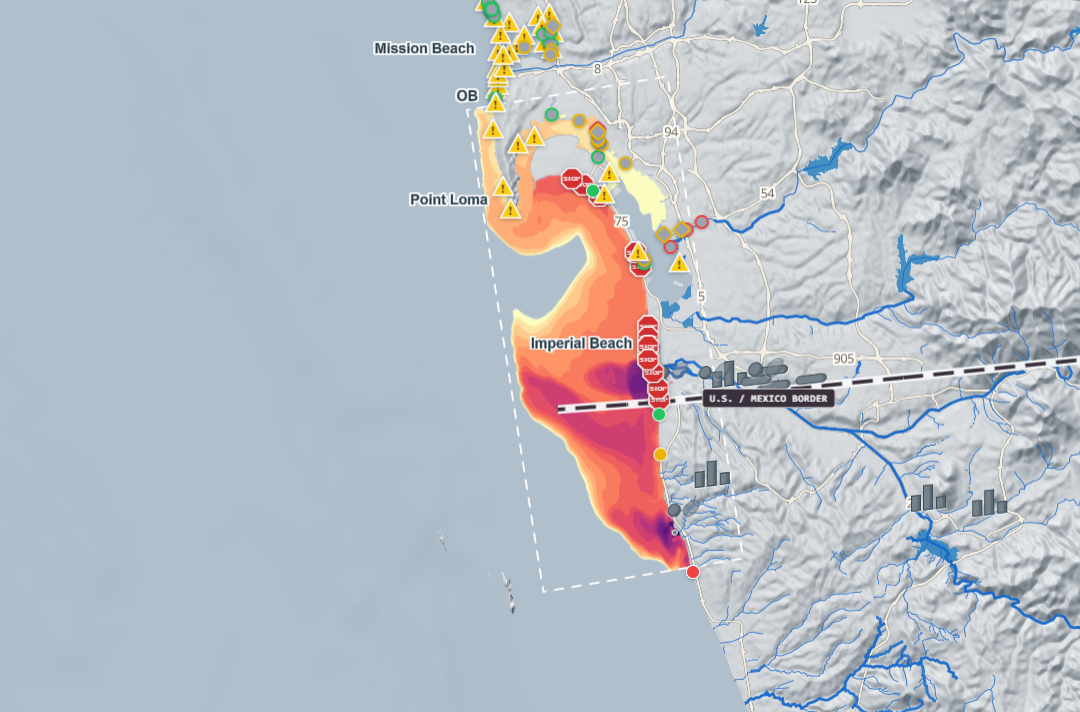
The geography of the crisis is unforgiving. The Tijuana River drains a watershed that lies mostly in Mexico. It flows north, crosses the border near San Ysidro, runs through the Tijuana River Valley and empties into the Pacific at the estuary just south of Imperial Beach. Whatever enters the river in Tijuana ends up on the American coast.
In theory, most of Tijuana’s wastewater never reaches the river. It is supposed to be collected by sewer lines, pumped to treatment plants and either treated in Mexico or sent across the border to the South Bay International Wastewater Treatment Plant on the American side. Even sewage that enters the river in Tijuana usually just sits there sometimes for weeks or months at a time, as the river is mostly a dry streambed there, at least until it rains.
In practice the system breaks constantly. When pipes collapse, when pumps fail, raw sewage spills into the river channel. And when it rains, the accumulated sewage swell flows north. Anytime it rains in San Diego, admittedly rare, beach closures tend to follow.
Once the sewage reaches the ocean, the currents decide where it goes, but it almost always flows north. Storm flows can push a sewage plume more than 12 miles out from the river mouth. In summer, south swells drive that plume up the Silver Strand toward Coronado. As much as 30 million gallons of sewage-contaminated water can enter the Pacific from Tijuana on a bad day. And Coronado is right in the target zone.
Tijuana’s Sewer System Was Never Built for Two Million People
Anyone who has spent time in Mexico knows the small sign next to the toilet: toilet paper goes in the wastebasket, not the bowl. The pipes are too narrow and the systems too fragile to handle it. It is a minor domestic habit commonplace in countries with older and less developed infrastructure. China has this too. Across much of the country, sanitation infrastructure has been built to the bare minimum, but has been stressed to serve far more people than it was designed for.
Tijuana is the extreme case. It is one of the fastest growing cities in North America, a manufacturing and border economy that has added hundreds of thousands of residents in a generation. Imperial Beach’s mayor has described the problem: Tijuana does not have the infrastructure to handle the sewage of its two million residents.
The failures in 2026 alone point to a significant problem:
January 2026: A three-mile collector pipe carrying about 900 liters of wastewater per second, collapsed. Roughly 11 million gallons of untreated wastewater a day poured into the river.
Late spring 2026: Ruptures in the Parallel Gravity Line sent 40 to 50 million gallons of sewage into the Tijuana Estuary.
The coastal plant: The San Antonio de los Buenos Wastewater Treatment Plant at Punta Bandera came back online after nearly eight months of delays, malfunctions and redesigns.
American's efforts to stave off the problem have not held up. The South Bay plant was completed in 1997 and was not designed to treat all of Tijuana’s wastewater. Subsequently, it was also allowed to deteriorate. As much as $150 million in deferred maintenance had to be addressed before the plant could be expanded.
Coronado Has Mostly Survived the Sewage Crisis So Far
Imperial Beach, just south of Coronado on the Silver Strand, has borne the worst of it. Its beaches have been closed for years: by 2024 the town had passed 1,000 consecutive days of closures. A beach town without a beach is is definitely missing something, and Imperial Beach’s small businesses have paid for it.
Coronado has been luckier, but its luck is getting thinner:
March 2026: County health officials extended the closure north to Avenida Lunar.
June 2026: Warning signs went up beside the volleyball courts on Coronado Beach.
July 2026: Glorietta Bay, on the protected bay side of town, and namesake of the hotel just behind the Hotel del Coronado, was closed after a sewage release.
September 8, 2026: The county closed the Coronado shoreline all the way through North Beach.
The County of San Diego has a website where they regularly update the status of the different beaches. Red = fully closed. Yellow = under advisory. The situation in 2025 and 2026 has had Imperial Beach and Silver Strand closed most of the time, and Coronado near the Hotel del Coronado closed much of the time.
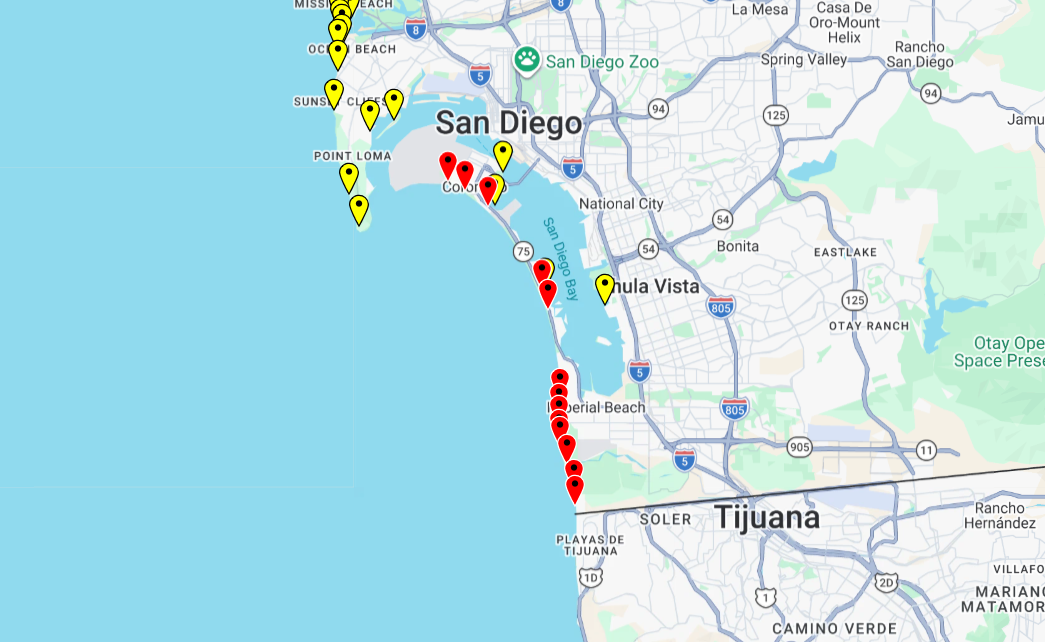
So far, the closures have been episodic rather than permanent. The Del is still full. Orange Avenue is still busy. Most visitors still leave with no idea that the water they swam in last month might have been closed this month. But the threat to Coronado is the town’s identity. Coronado continues to be a dreamy beach town because it has a perfect beach in a perfect small town. If you can't swim in the beach, while it doesn't destroy a vacation, it definitely dents the image.
The crisis also reaches past tourism. Naval Amphibious Base Coronado is where Navy SEALs train, much of it in the ocean, and the contamination has disrupted that training. Inland, the river valley regularly records spikes in hydrogen sulfide from the sewage, and San Diego County has handed out 12,000 air purifiers to households near the river.
The United States Is Now Paying to Treat Mexico’s Sewage
The policy debate comes down to the choice of whether the United States should pay to protect its own coast, even when the problem is being caused in Tijuana, or pressure Mexico to fix its own sewage?
The pressure strategy has been long, but with mixed results:
Minute 328 (2022): The US and Mexico committed to a package of sewage projects.
July 2025 memorandum: EPA Administrator Lee Zeldin signed an agreement in which Mexico promised to pay its remaining $93 million under Minute 328, split between its 2026 and 2027 budgets.
Minute 333 (December 2025): The two countries added infrastructure projects, monitoring and long-term maintenance planning, the last of which earlier agreements had lacked.
Mexico has made progress under that pressure. It has rehabilitated major interceptor lines and begun diverting treated effluent away from the river. Tijuana’s city council has demanded that Mexico’s national water agency clean and maintain the river channel. After all, Tijuana’s residents live next to the sewage too.
But pressure moves at the speed of diplomacy. So the United States has been forced to expedite money to the problem anyway. In 2025 the federal government expanded the South Bay plant from 25 to 35 million gallons per day in 100 days, a job originally scheduled to take two years. Subsequently, a $600 million program will rehabilitate the plant and double its capacity to 50 million gallons per day, with peak capacity of 75. The first major construction contract for that next expansion was awarded this year.
It's a hard pill to swallow, but probably overdue. Six hundred million dollars sounds like a staggering sum to spend treating another country’s sewage. But it is less than the public contribution to the Buffalo Bills’ new stadium. In return the country protects one of its most valuable coastlines, a major naval training ground and the health of hundreds of thousands of people in south San Diego County. Paying for the plant is both charity toward Mexico but also strategic coastal defense.
The treatment plant should help, but it won't solve the underlying issue fully. When a pipe collapses in eastern Tijuana, the sewage goes into the river, not the plant. The United States can build all the capacity it wants on its side of the border, but the pipes that feed it are Mexico’s. The realistic answer is that the US needs to protect everything on the American side without waiting for anyone, and hold Mexico to its schedule for everything on the other side.
A Small City Cannot Fix a Binational River
Coronado is a city of roughly 20,000 people. It cannot build a treatment plant, negotiate a treaty or repair a sewer line in another country. It has no jurisdiction over the river, the plant or the ocean currents. Its tools are lobbying, litigation and attention. The frustration with this has been abundant in local public discussions, which have at times bubbled into anger and frustration, but mostly a feeling of helplessness and inaction.
Pressure campaigns are its greatest tool. Imperial Beach spent years closed while the crisis remained a regional story about a working-class surf town. The crisis became a national story when the closures reached the Del and the SEALs. Coronado has wealth, retired admirals, national media recognition and a Navy installation. Those are forms of leverage Imperial Beach never had. Coronado should use every bit of it, and it should use it on behalf of the whole Silver Strand rather than just its own shoreline.
Coronado needs to push to get this done fast. The federal money is now appropriated and the agreements are signed. But the project has been delayed by procurement, environmental review and the slow rhythm of a binational commission. Welcome to California, welcome to the federal government. Local leaders have already called for faster environmental review under state and federal law to get these projects built. A small city cannot pay for a sewage system. It can at best make delay politically expensive.
Bring On El Niño...
Forecasters expect a strong El Niño this winter, with heavy rain and flood risk running from October through April. The rain should make the Tijuana River run heavy, so expect heavy sewage flows.
Crews have cleared more than 16,000 feet of the river channel to reduce flooding in anticipation. They have completed the Parallel Gravity Line rehabilitation and begun the second phase of the Tijuana River Gates project, which is meant to keep about 5 million gallons of sewage a day out of the river and is due in early 2027. The plant expansion is underway. None of it was finished in time for the storms of past decades, but with luck some of it may be finished in time for this one.
At sunset on Coronado Beach the water turns gold, then pink, then dark, and the fire pits outside Serēa light up one by one. From the sand, the ocean looks exactly as it has for a century: clean, endless and perfect. Whether it is safe to swim in is questionable, dictated by the county website and a lifeguard truck with a loudspeaker. Coronado still has the most beautiful beach in California. This winter will show how much of it the town gets to keep.


